
Hand osteoarthritis
Arthritis in the finger joints that causes pain, swelling and stiffness.
For hand, thumb and wrist arthritis pain that hasn't responded to splints, therapy or medicine, our team evaluates whether TAME may be an option.

Arthritis in the finger joints, at the base of the thumb or in the wrist can make it hard to grip, write, open jars or do everyday tasks. Hand arthritis often involves inflamed, swollen joints.
Care usually starts with splints, hand therapy and medicine. When pain keeps going, transcatheter arterial microembolization (TAME) may calm the inflamed joints. Research on TAME for the hand and wrist is at an early stage, and your specialist will talk with you about what is known, the possible benefits and risks, and other treatments.
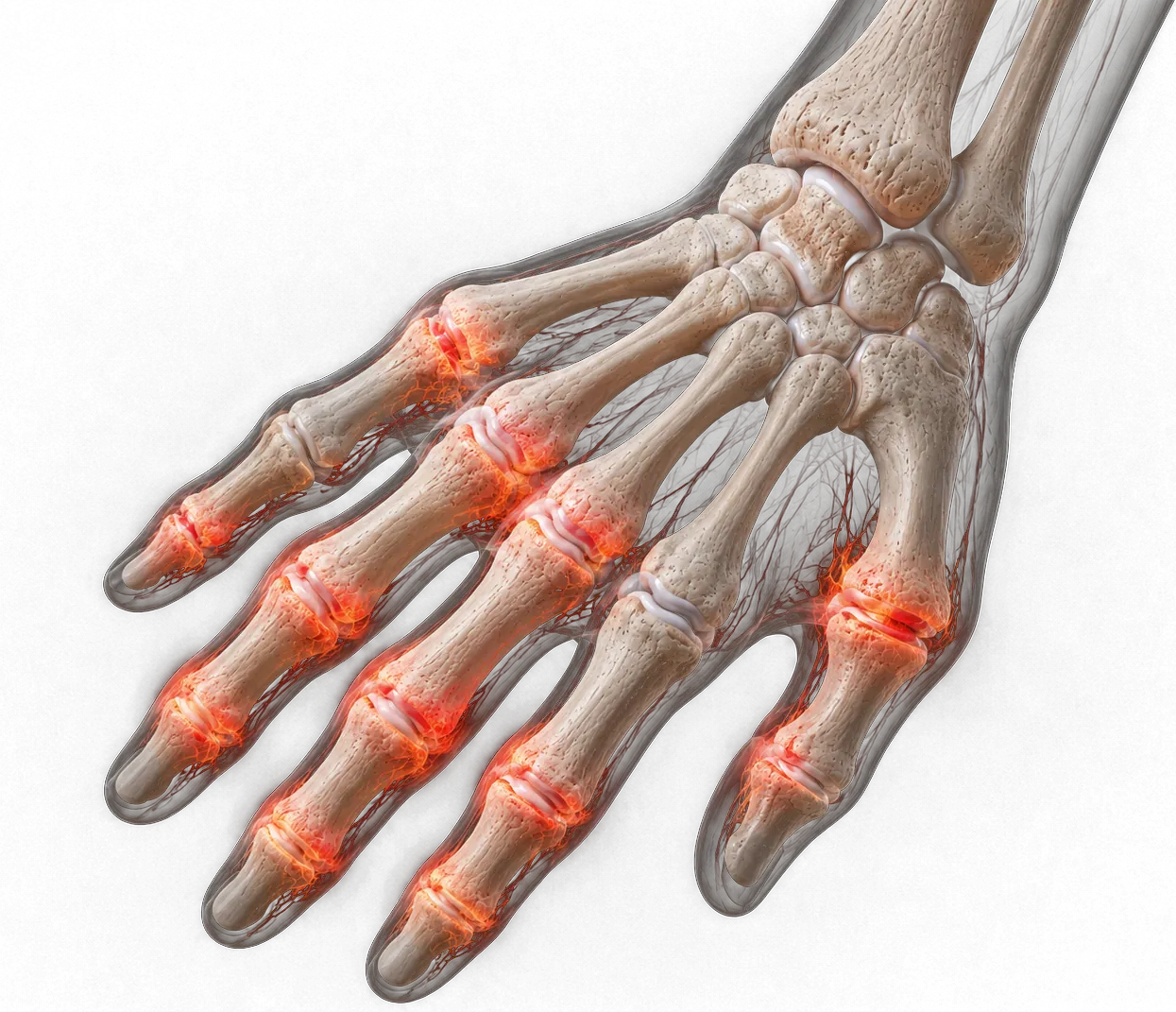
If any of these keep you from the things you enjoy, a visit can help find the cause and the options that fit you.
Arthritis in the finger joints that causes pain, swelling and stiffness.
Arthritis at the base of the thumb that makes gripping and pinching painful.
Long-lasting wrist pain from arthritis or an old injury.
Raynaud's or poor blood flow to the fingers needs a closer look, since it may mean TAME is not a good fit.
Every plan starts with an evaluation. Your provider reviews your history, imaging and the treatments you have tried, then explains which options may fit.
Splints rest painful joints, and hand therapy builds strength and protects your joints. Tools with large grips can make daily tasks easier.
Who it may help: Everyone with hand or thumb arthritis pain.
Topical or oral anti-inflammatory medicines and joint injections can ease pain for some people. Your specialist can also discuss PRP injections.
Who it may help: People whose pain continues despite splinting and therapy.
A thin catheter is usually placed in an artery at the wrist. Contrast dye and X-ray find small arteries with extra blood flow around the painful joints, and tiny particles are released to reduce that flow. Because hand arteries are very small, extra-fine catheters and small amounts of particles are used.
Who it may help: People with persistent hand, thumb or wrist arthritis pain despite splinting, therapy and medicine.
Our team checks your insurance before your visit.
We review your history, examine your hand and wrist and look at your imaging. Bring your medication list, insurance card, recent X-rays or MRI reports, and a list of treatments you have tried.
You and your specialist make a plan together, usually starting with the simplest options. We explain benefits, risks and alternatives, and if a procedure is not a good fit, we will tell you and suggest next steps. We check your insurance before anything is scheduled.
If you are a candidate, the procedure is done at our main center through a small puncture, with numbing medicine and relaxing medicine. Most people rest a few hours and go home the same day.
We check in after treatment and track your pain, grip and daily tasks. Hand therapy helps as pain eases.

Dr. Kumar is a board-certified cardiologist and vascular specialist who leads the Heart Vascular & Leg Center and Advanced Joint Pain & Vascular Center team. He treats arterial and venous disease, nonhealing wounds and joint pain with minimally invasive, image-guided techniques, and trained in joint embolization in Tokyo with Dr. Yuji Okuno.
Transcatheter arterial microembolization uses the same approach as knee GAE. It reduces blood flow to small vessels around inflamed hand or wrist joints to calm inflammation and ease pain.
The finger joints, the base of the thumb and the wrist. Your specialist will ask which joints hurt most and review your imaging.
People with Raynaud's, scleroderma or poor blood flow to the fingers may not be a fit. Tell us if your fingers change color in the cold. An active infection, advanced kidney disease or a severe contrast dye allergy may also rule it out.
Early studies have reported pain improvement, but research is at an early stage. Results vary from person to person.
It is done through a tiny puncture, not surgery, but like any procedure it has risks. The most common are soreness, a short-term increase in joint pain and a bruise at the puncture site. Less common risks include temporary skin color change over the treated area, a reaction to contrast dye, infection or injury to the artery. Your specialist will talk through the risks for someone like you before you decide.
Coverage for joint embolization varies, and some plans consider it still being studied. Before your visit, our team verifies your coverage, referral requirements and any expected costs. We accept Medicare and many other plans, but plan acceptance does not mean every procedure is covered.
Enter your ZIP code or city to see our offices sorted by distance. Procedures are done at our main center; our other offices see patients for consultations and follow-up visits.
Find the center that matches your symptoms. Each one is part of Advanced Joint Pain & Vascular Center, a division of Heart Vascular & Leg Center.